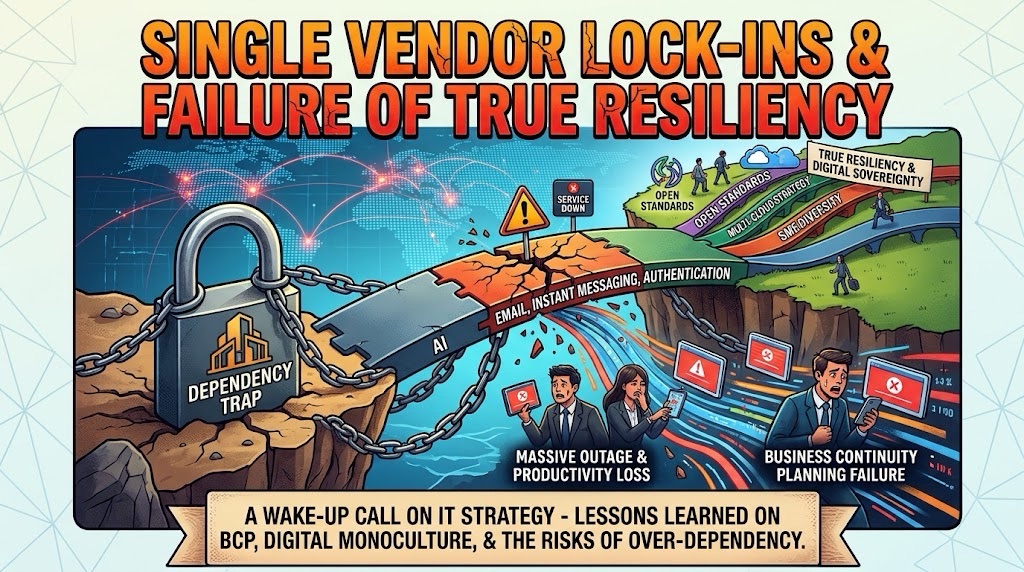
By the time this post is released, the massive outage and losses of productivity and economy caused by massive outage by the popular IT giant might be forgotten. This outage (also) gives the harsh reality of how single-vendor dependency can cause global outage and productivity losses.
There was a discussion in Singapore Computer Society a month ago that focused on these key questions:
- What is AIs role in BCP?
- What happens if AI fails us? Whose responsibility is it?
- Can/How does our reliance on AI contribute to the resilience of AI?
But the recent outage forced us to think about foundational concept to IT resilience, not just AI availability.
By the time I write this, the outage is being resolved in phases. The affected vendor announced progress in stability in the services. I started receiving emails in my inbox.
Before we move further, let’s look at the damage caused by this outage.
It was 13th November. I went to bed early on the previous day, hence I got up early and tried to begin my morning routine. My web email loaded at first, but soon I saw errors on browser. I got similar errors in AI service, calendar service of the same vendors chosen by my IT team. Communication mechanism was still working within organization, which was the biggest relief as I had an important meeting that day. The outage continued throughout the day. Our customer support became muted, our non-vendor related internal services which uses authentication based on the affected SSO became unavailable, though our services are running fine. Until I left my office that evening, the problem persisted.
The service not only affected us, but also the key banking, healthcare and other public services of Singapore and other services.
Couldn’t we avoid such massive outage caused by single point of failure?
Many people discussed about the evil that brought by Digital Monoculture. During on-prem era, we had different email services hosted by email servers run by Microsoft Exchange, Lotus Notes, Sendmail, PostFix etc. If an email service of a company is affected, it will affect a single company alone, not the entire world. The aggressive push toward the cloud forced organisations to migrate to cloud without worrying about multi-cloud strategy. Cloud companies themselves do not like Multi-cloud ecosystem. Such design caused this massive outage, which raised key questions.
- Single point of failure: Several millions of subscribers used the affected services. An outage in the core services of the single IT vendor like DNS, Entra ID or Exchange Online it caused massive outage on the global public services.
- Architecture coupling: Earlier, email and authentication were not tightly integrated. But the modern IT managers happily chose a tightly coupled authentication, email, instant messaging, security, and AI services. So a problem in one service affects the entire organization.
Putting all your IT eggs in one basket creates a digital monoculture that puts entire businesses at risk, warned CheckPoint Software.
“You can’t outsource risk,” he said. “Risk is something you have to own as an organisation.” as pointed by Mr Matthew Hardman, Asia-Pacific chief technology officer at Hitachi Vantara and a former Microsoft executive as highlighted by CNA
Why IT leaders still choose this path?
It is a bitter reality to see C level executives and IT managers buy the story of moving to hyperscalers when cloud era started. We need to note that similar push is given for their IT services now. Liability shifting, licensing, lower cost (to be really validated) are cited as the reasons for such decisions. But frequent failures raises a question about their resiliency forced few organizations to discuss about alternate way of achieving business continuity.
If they choose Hyperscalers, no employees will be sacked for the service outage. But when hyperscalers fail, it is accepted as if it is a natural calamity! But SMEs do not have such leverage. When an SME’s service goes down for few hours, they will be pressurized to meet their SLAs, penalties will be imposed, and they will be shown the door.
Such double standard exists in the industry for several decades. There are few reasons for this behaviour.
1. Shared Misery & Psychological Safety:
IT manager’s biggest worry is, the outage should not be caused by his own decision alone. If he chose a SME to provide such service and the service goes off for brief hours, he is forced to justify his decision of choosing that SME when hyperscalers are ruling the IT world.
So, when hyperscalers faces outage, 80% of the global companies and public services are affected . It is convenient for IT manager to inform his manager that it is the problem of the IT Giant and we are not alone!and it is forgiven. It is not our own problem , it is a global problem!
2. The cost of looking for an alternative:
Hyperscalers not just provide email service. Authentication, Instant Messaging, AI, File sharing etc are also controlled by them. It is simple to replace an SME – just by changing APIs. But if you decide to replace a major vendor, it will cost a fortune and take years. It needs extensive training. Such vendor-lock-in will give the hyperscalers a kind of complacency.
3. Asymmetric power dynamics:
SMEs are forced to retain their customers. So they signed in tight SLAs and they are forced to meet their obligations. But hyperscalers play a different game. They decide their SLAs. (AI companies try to define how world should assess AI safety – is it also of that kind). Even if they do not meet their SLAs they can close the case by offering some service credits. They never compensate organization’s business losses, which are much much bigger than the service credits offered to them. IT managers knew this and signed their contract.
4. The good-enough mentality:
The hyperscaler practiced such policies since the beginning. Grab the market at cheap price, kill the competitors, give the software for free or at a lesser cost to educational institutes to lock the students to their technology and worry about service quality later. Email infrastructures provided by Lotus Notes, Novell Netware are technically stable and scalable. The IM provided by Lotus notes of 90s and 2000s are more stable and easy to use than the IMs provided by hyperscalers of 2020s.
But C executives and IT managers give importance to the reasons explained above to switch from the best of their own domain to bundled vendors.
5. Amnesia driven marketing:
Such massive outage will also be forgotten, when the same giant offer some services for free or release new feature in the forthcoming weeks. IT Media, IT managers and executives will turn towards the new feature and forgot about the damage caused by this massive outage.
The need of the hour:
- The business services should communicate with each other based on open-standards not based on tightly coupled services of a single vendor.
- The sovereignty of the organization should not be compromised by cost-cutting
- Organisations to have same standards irrespective of the size of their vendors.
—
Human written article
Featured image: Gemini